
工厂上 AI,先问能解决哪个问题
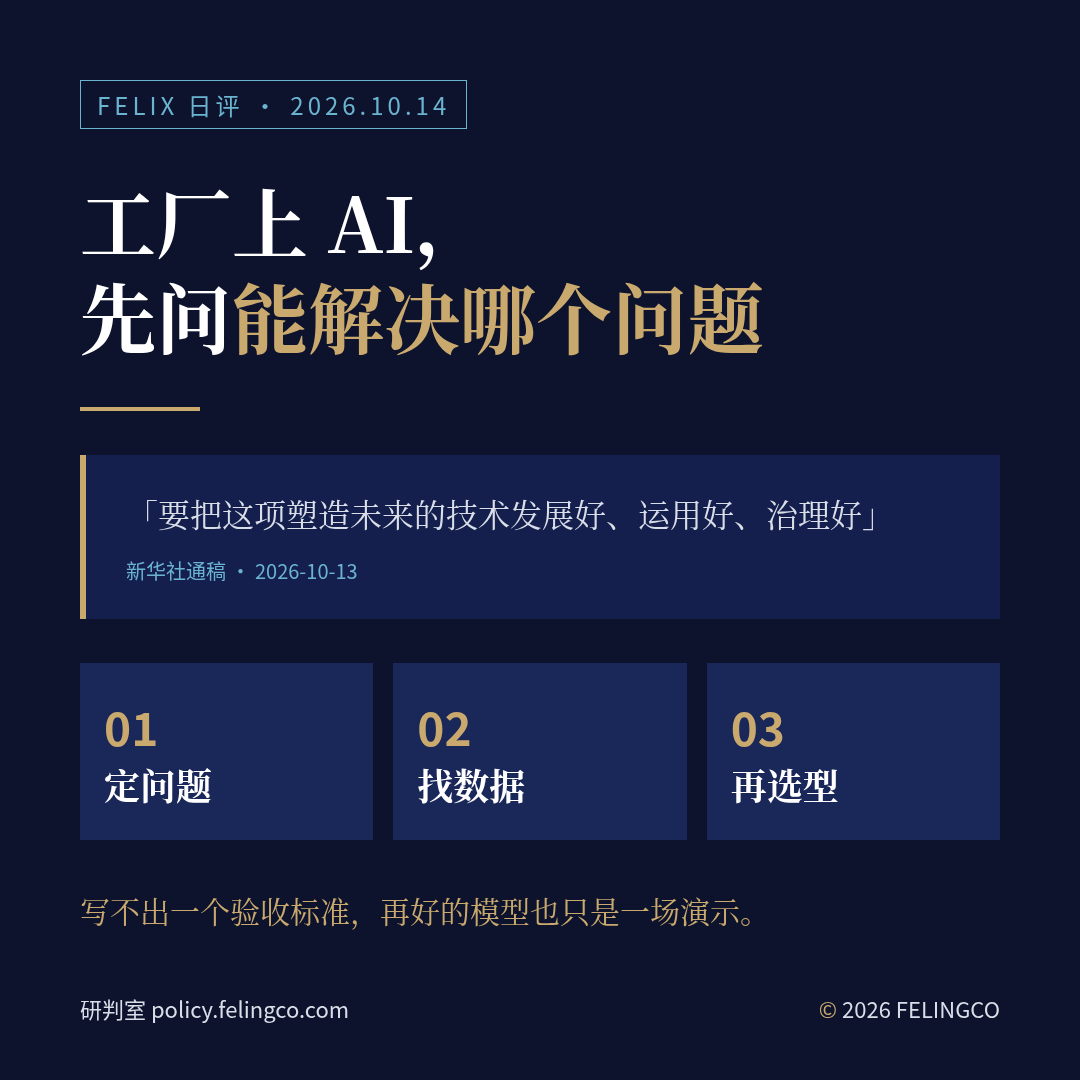
中共中央政治局常委、国务院副总理丁薛祥把 AI 放在「产业变革」的位置上,要求将其「发展好、运用好、治理好」。我的看法是,工厂老板真正要接住的是「运用好」这一条。而运用好的起点不是挑哪款大模型,而是先锁定一个能验收、能算账的车间问题,再看数据够不够,最后才轮到选型。
一、通稿说了什么
10月13日,丁薛祥在北京会见清华大学经济管理学院顾问委员会委员代表,重点围绕人工智能发展和治理同委员们交流[G1]。他指出:「人工智能是引领新一轮技术革命和产业变革的关键力量,要把这项塑造未来的技术发展好、运用好、治理好,更好造福全人类。」[G1] 他还欢迎大家「支持和参与世界人工智能合作组织建设,促进共同繁荣、维护共同安全」[G1]。
通稿很短,没提补贴,也没提申报安排。但工厂老板值得多看一眼「产业变革」这个定位。
二、「运用好」这一条,离车间最近
三个「好」里,发展和治理关乎底层研发、规则制定与国际合作,离一家工厂的日常较远。「运用好」不一样,它最终要在一条条产线上见真章。
这能和10月9日发布的《中共中央 国务院关于发展新质生产力的意见》对上。那份文件明确提出「推进人工智能对传统产业的改造」[Y16],靶子直接立在传统产业上。当然,这是我把两份材料放在一起读出的判断,并非通稿原话。
问题在于,「用 AI」这三个字太宽。买套大模型、上个数字人客服,都算用了 AI;但这些投入能不能在车间里验收,很难说清。我的建议是倒过来想:先定问题,再找数据,最后选工具。
三、假设一家紧固件厂,我会这样问
下面是一个假设场景,不对应任何具体企业。
第一,哪个问题有硬性的验收标准? 冷镦、搓丝、热处理、表面处理、检测,逐道工序过一遍。外观缺陷挑拣、热处理参数异常预警、模具寿命预测,这类问题至少有据可查:挑出来的件准不准,预警后有没有真出异常,模具是不是在预判的节点损耗。「智能决策」「AI 大脑」这类说不清怎么验收的词,先往后放。
第二,这笔账怎么算? 光有验收标准还不够。得算清楚:前期投多少,人工复核还要留几个人,漏检和误报各会造成多大损失,试运行多久算一个周期。算不平账的项目,演示再漂亮也先别签。
第三,这个问题需要的数据,现在在哪? 比如一台冷镦机每班打多少件、什么时候断模、哪一炉热处理硬度偏了。如果这些记录还停留在纸质报表或老师傅脑子里,那第一步是把这一个问题的数据采上来,而不是急着上模型。不必一口气盘全厂,盘清一条线、一个问题就够起步。
第四,换供应商,数据能不能带走? 选型时把这几条写进合同:设备数据和工艺参数存在哪,能不能按通用格式导出,合作结束后能不能完整取回。工艺参数是工厂的家底,不能锁在别人的系统里。
第五,机器判的,谁来复核? 通稿把「治理好」与发展、运用并列。落到车间,「治理」就是责任边界。建议从第一天起就留好底档:哪些判定是系统下的,人在哪一步复核,出了偏差怎么追溯。这些记录,日后客户验厂、体系审核都用得上。
四、我的判断
这次会见没有释放能马上申报的政策,工厂不必为一条新闻去抢预算。但高层把 AI 定位为产业变革的关键力量,再叠加上周新质生产力文件里「推进人工智能对传统产业的改造」的提法,可以预见,车间里的 AI 应用会被越来越频繁地拿出来讨论,软件商的推销电话也会跟着变多。
接电话之前,先在纸上写下一个痛点、一套验收标准、一笔明白账。写得出来,再谈选型;写不出来,再好的模型也只是一场演示。
---
Felix
原文与来源
- [G1] 新华社:丁薛祥会见清华大学经济管理学院顾问委员会委员代表(2026-10-13 21:37),中国政府网转载:www.gov.cn
- [Y16] 《中共中央 国务院关于发展新质生产力的意见》(2026-10-09):www.gov.cn
Before Putting AI on the Factory Floor, Ask Which Problem It Can Solve
Ding Xuexiang, a member of the Standing Committee of the Political Bureau of the CPC Central Committee and Vice Premier of the State Council, placed AI in the frame of “industrial transformation,” calling for it to be “developed well, applied well, and governed well.” My view: what factory owners should actually catch is the “applied well” part. And applying it well does not start with picking a large model. It starts by locking onto one shop-floor problem that can be accepted and costed, then checking whether the data are enough, and only then choosing tools.
1. What the official report said
On Oct 13, Ding Xuexiang met in Beijing with representatives of the Advisory Board of Tsinghua University’s School of Economics and Management and exchanged views with them mainly on AI development and governance [G1]. He said: “Artificial intelligence is a critical force leading a new round of technological revolution and industrial transformation. We must develop, apply, and govern this future-shaping technology well, so it better benefits all of humanity.” [G1] He also welcomed them to “support and take part in building the World Artificial Intelligence Cooperation Organization, promote shared prosperity, and safeguard shared security” [G1].
The report is short. It mentions neither subsidies nor any application window. Factory owners should still look carefully at the framing of “industrial transformation.”
2. Of the three “wells,” “applied well” is closest to the shop floor
Of the three “wells,” development and governance sit closer to fundamental R&D, rule-setting, and international cooperation—farther from a factory’s day-to-day. “Applied well” is different: it has to prove itself on real production lines.
That lines up with the Opinions of the CPC Central Committee and the State Council on Developing New Quality Productive Forces released on Oct 9. That document explicitly calls for “advancing the transformation of traditional industries with artificial intelligence” [Y16], aiming squarely at traditional industries. To be clear, that is my reading when I put the two materials side by side—not wording from the meeting report itself.
The problem is that “using AI” is too broad. Buying a large model or adding a digital customer-service avatar both count as “using AI,” but whether those spends can be accepted on the shop floor is hard to say. My suggestion is to reverse the order: define the problem first, find the data second, pick the tool last.
3. If this were a fastener plant, here is how I would ask
The scenario below is hypothetical. It does not refer to any specific company.
First: which problem has a hard acceptance standard? Walk the line—cold heading, thread rolling, heat treatment, surface finishing, inspection. Sorting appearance defects, flagging unusual heat-treatment parameters, predicting die life: these at least leave a trail you can check—were the sorted parts correct, did an anomaly really follow the alert, did the die wear out around the predicted point. Put fuzzy phrases like “intelligent decision-making” or “AI brain,” which cannot be accepted clearly, further down the list.
Second: how does the cost account balance? An acceptance standard alone is not enough. You need the numbers: how much upfront spend, how many people still needed for human review, what losses false negatives and false positives each create, and how long a trial run counts as one cycle. If the account does not balance, do not sign—no matter how polished the demo.
Third: where is the data this problem needs today? For example: how many pieces a cold header runs per shift, when a die breaks, which heat-treatment batch ran soft. If those records still live on paper forms or in a senior operator’s head, step one is to capture data for this one problem—not to rush a model online. You do not need to map the whole plant at once. Clearing one line and one problem is enough to start.
Fourth: if you change vendors, can you take the data with you? Write these into the contract at selection: where equipment data and process parameters are stored, whether they can be exported in a common format, and whether you can retrieve them in full when the engagement ends. Process parameters are the factory’s core assets. They must not be locked inside someone else’s system.
Fifth: when the machine judges, who reviews? The report places “governed well” alongside development and application. On the shop floor, “governance” means the boundary of responsibility. From day one, keep a clear record: which calls the system made, at which step a person reviewed, and how deviations are traced. Those records will matter later in customer audits and system reviews.
4. My judgment
This meeting did not release a policy you can apply for tomorrow. Factories need not scramble budget for one news item. But with the leadership framing AI as a critical force for industrial transformation, plus last week’s language on “advancing the transformation of traditional industries with artificial intelligence,” shop-floor AI will come up more often—and software vendors’ sales calls will follow.
Before you take those calls, write on paper one pain point, one acceptance standard, and one clear cost account. If you can write them, then talk selection. If you cannot, even the best model is only a demo.
Felix
Sources
- [G1] Xinhua: Ding Xuexiang meets representatives of the Advisory Board of Tsinghua University’s School of Economics and Management (2026-10-13 21:37), carried on the Chinese government website: www.gov.cn
- [Y16] Opinions of the CPC Central Committee and the State Council on Developing New Quality Productive Forces (2026-10-09): www.gov.cn
The above is research observation and does not constitute investment advice.
本内容用于政策学习、产业观察与企业经营交流,不提供任何投资建议。以上为研究观察,不构成投资建议。
For educational and business observation only. Does not constitute investment advice.
© 2026 FELINGCO
本栏目内容用于政策学习与市场观察交流,不构成任何投资建议;涉及官方日程与数据的,以官方发布为准。