
GitHub 疯了?那个隐退3年的大佬一回归,就把 App 的未来判了死刑
首发于微信公众号「田野与浪潮」 · 阅读原文 ↗
这张图,大家最近在刷到了吗?
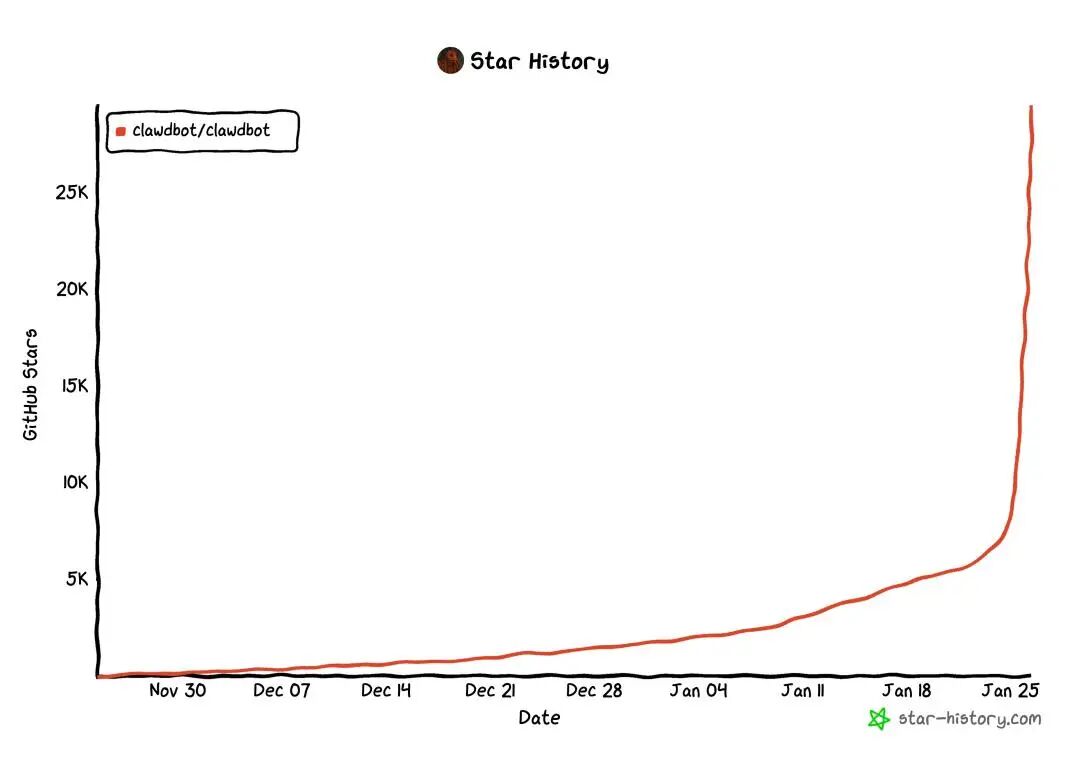
如果不看坐标轴,我以为是哪只妖股的K线图。但实际上,这是一个开源项目的 Star 数增长曲线——简直就是一条垂直的线。
项目叫MoltBot(之前叫ClawdBOT,太火了被官方“请”去改名了)。
在这个曲线背后,是一个更有意思的故事。甚至可以说,这可能是最近硅谷最“细思极恐”的一场对话。
创始人 Peter Steinberger,一个隐退江湖三年的老兵,最近接受了 John Coogan 的采访。我不夸张地说,看完这几十分钟的访谈,我后背发凉,同时也兴奋得睡不着觉。
因为他用亲身经历告诉我们:很多我们熟悉的App,可能真的要消失了。
01 隐退三年,他是去“修仙”了吗?
Peter 不是什么为了改变世界而创业的热血青年。
相反,他是一个已经“赚够了”的退休老板。卖掉上一家公司后,他彻底倦怠了,据他自己说是过了三年“花天酒地”的日子。整整三年,一行代码没写。
这简直就是爽文男主的开局。
直到 AI 出现。他说感觉自己被吸干的“魔力”又回来了。
他回归的理由特别单纯,单纯到让那些整天把“赋能”、“闭环”挂在嘴边的创业者汗颜——为了好玩(Have Fun)。
他不想融资,不想搞SaaS,就想给自己手搓一个能聊天的私人助理。结果一不小心,搓出了一个让硅谷 VC 排着队想送钱的项目。
02 “我的 Agent 居然学会了自己拿主意”
采访里有个细节,特别炸裂。
Peter 在摩洛哥旅游的时候,随手给自己的 Agent 发了一条语音。但他其实根本没写处理语音的代码,按理说程序会报错。
结果 10 秒钟后,Agent 回复了。
它说:“老板,你发的是个 Opus 格式的音频,我没工具解压。但我查了一下你电脑里有 FFmpeg,我就自作主张把它转成了 Wave 格式。然后我发现你没装 Whisper,但我翻了下你的环境变量,发现你有 OpenAI 的 Key,我就把音频发给 OpenAI 转成文字了。你要说的是这个事儿吧……”
听听,这是程序吗?这简直是个成了精的私人秘书!
以前我们写代码,是告诉电脑“第一步做什么,第二步做什么”。
现在的 Agentic Engineering(代理工程),是告诉 AI:“我想喝水”,然后它自己去找杯子、找水源、甚至自己烧水。
这就是变天的地方。
03 暴论:App 正在融化
Peter 在访谈里抛出了一个让我思考了很久的观点:
“App 正在融化(Melt away)。”
仔细想想,不仅是融化,简直是降维打击。
他举了个例子:以前我们要减肥,得打开 MyFitnessPal,搜索食物,输入克数,计算卡路里……烦都烦死了。
但在 Peter 的世界里,他只需要随手拍张照发给 Agent。
Agent 知道他在麦当劳(定位信息),知道那是高热量垃圾食品(视觉识别),甚至会直接告诉他:“既然这顿吃了金拱门,那我把你明天的健身计划调整一下,多跑两公里。”
整个过程,没有 App 被打开。
数据不再被锁在大厂的围墙花园里,而是通过 Agent 在底层 API 之间自由流动。这就叫“数据解放”。
如果未来每个人都有这样的 Agent,那些功能单一的 App,除了沦为一个提供数据的 API 接口,还有存在的必要吗?
04 代码一文不值?
对于开源,Peter 的态度更是“杀人诛心”。
有人问他:你不怕别人把你的代码拿去卖吗?
Peter 摊手:“让他卖呗。现在的代码值几个钱?”
这话说得太狂,但也太真实。在 AI 辅助编程如此强大的今天,代码本身已经不是护城河了。你把他的代码全删了,他可能一个月就能再写一套出来。
护城河不再是代码,而是想法,是品牌,是关注度。
写在最后
Peter 说,去年是 Copilot(辅助写代码)之年,而今年,是 Personal Assistant(私人助理)的元年。
他甚至为了跑大模型,买了一台顶配的 Mac Studio。你看,连硬件需求都被倒逼着升级了。
这个故事给我的触动很大。如果你是一个开发者,或者是对 AI 感兴趣的普通人,别再纠结什么“风口”了。
像 Peter 一样,去玩,去折腾,去 Have Fun。
因为在这个时代,一个人,真的可以活成一支队伍。
本文基于Peter Steinberger最新访谈整理。
你认为未来的App真的会消失,变成AI调用的一个个API吗?欢迎在评论区留下你的看法。
附上访谈英文总结和实录
Summary
The discussion centers on Peter Steinberger's return to software development after a hiatus, marked by his exploration of AI and the creation of the viral open-source project, now named "MaltBot." Steinberger details his journey back into coding, driven by a desire to experiment with new technologies and build useful tools, emphasizing the importance of having fun in the learning process. He recounts the pivotal moment when his agent autonomously handled a voice message, showcasing the resourcefulness of AI. Steinberger also touches on the shift towards personal AI assistants, the liberation of data, and the potential disappearance of traditional apps as AI integrates across platforms. He expresses a desire for community involvement to help maintain the project.
Takeaways
Personal AI assistants are poised to become a major trend, potentially eclipsing the focus on browser-based agentic experiences.
Building CLIs is crucial for agentic engineering because agents understand Unix and can leverage numerous small programs via help menus.
The most effective way to learn new technologies is to have fun and play with them.
The liberation of data, even against the wishes of big tech, is facilitated by running AI locally, bypassing red tape and restrictions.
Many apps may become obsolete as AI agents can consolidate their functions and interact with underlying APIs directly.
Building software for AI models, rather than humans, improves functionality by aligning with how the models think.
Open source should be made so good that there is not a lot of space for people to convert it and make it their own thing.
The value of a project lies more in the idea, eyeballs, and brand than in the code itself.
Agentic models have advanced to the point where a single person can achieve the output of an entire company from a year ago.
The current AI models represent the worst they will ever be, with continuous improvements expected in ease and speed.
Keywords
| Cloud Code | A service that allows developers to build, test, and deploy cloud-native applications directly from their IDEs (Integrated Development Environments). Peter Steinberger mentions Cloud Code as his entry point into exploring AI, finding it "pretty awesome" and sparking a renewed interest in coding. |
|---|---|
| Agentic Engineering | A term used by Peter Steinberger to describe a development approach focused on building software with AI agents. He contrasts it with "white coding," implying a more experimental and less structured approach to software development. |
| FFmpeg | A free and open-source software project consisting of a suite of libraries and programs for handling multimedia data. In the podcast, it is mentioned as a tool used by the AI agent to convert voice messages from Opus format to Wave format for transcription. |
| Whisper | An automatic speech recognition (ASR) system developed by OpenAI. Peter Steinberger's AI agent initially attempted to use Whisper for transcribing voice messages but ultimately used OpenAI's API instead. |
| Opus | A totally open, royalty-free, highly versatile audio codec. Peter Steinberger mentions that his AI agent was able to identify Opus as the format of a voice message file and process it accordingly. |
| Prompt Injection | A security vulnerability in AI systems where malicious input (prompts) can manipulate the model's behavior. Peter Steinberger acknowledges that prompt injection is an unsolved problem and a risk for his project. |
| Codex | A set of models created by OpenAI to translate natural language to programming code. Peter Steinberger states a preference for Codex for coding tasks due to its ability to navigate large codebases effectively. |
| Minimax 2.1 | An open-source AI model. Peter Steinberger mentions that he can run Minimax 2.1 on his Mac Studio, considering it one of the best open-source models available. |
| Kimi | An AI model. Peter Steinberger mentions Kimi as a new model he hasn't had a chance to try yet. |
Highlights
💡I mean, honestly, my main mantra is I want to have fun. The best way to learn these new technologies is if you have fun with it.
💡But I see this project as as much technology as it is like art and exploration because This feels, in one way, it's just glue. It's just putting pieces together that we already have. In another way, it's a whole different way how you interact with those things because all the technology blends away.
💡I would say last year was the year of the coding agent. This year is the year of the personal assistant.
💡So this is a little bit the liberation of data that big tech probably doesn't really want.
💡And you also don't forget this is the worst that the models ever are. This is only going to go up.
💡You know, code is not worth that much anymore. You could just delete that and then build it again in a month.
Mindmap
Part 1: Personal Journey, AI Rediscovery
Part 2: MultBot Development, Technical Insights
Part 3: Scaling, Management, Future Vision
Part 4: Open Source, Legacy
Transcript
Peter Steinberger's Return to Coding: From Burnout to AI Enthusiasm
📝Peter Steinberger discusses his return to coding after a three-year break following 13 years of running his own software company. He describes feeling burned out and needing a break, referencing a period of "blackjack and hookers." After recovering, he felt his "spark" return in April and decided to explore web development and AI, areas where he lacked experience. He found the release of Cloud Code particularly exciting, leading to a renewed addiction to coding and the creation of a meetup group called "Cloud Code Anonymous," later renamed "Agents Anonymous."
John Coogan:How are you doing?
Speaker 2:Thank you so much for staying up late. What time is it for you? It's 11. Thank you so much.
John Coogan:We really appreciate it. for everybody that's just tuning in.
Speaker 2:Yes, 11 p.m. So I'd love to kick it off with just a brief background on when you started this project, a little bit of your career, how you're thinking about it going forward, and then I have a million questions.
John Coogan:This was your very first project ever, right?
Speaker 2:Yeah, yeah, yeah. First time coding, right?
John Coogan:Now, we were enjoying a screenshot of your GitHub profile earlier and just seeing how many different things.
Speaker 2:An overnight success.
John Coogan:A true overnight success. Yes. But we're super excited to have you here.
Speaker 2:Yeah.
Peter Steinberger:Awesome. Yeah, I'm excited to be here as well. Yeah, I don't know. I worked for my own software company for 13 years and then I sold it about four years ago. Then I was completely burned out. I did like, I mean it's TV but still, I did blackjack and hookers.
John Coogan:Well, we're glad you're back in the game.
Speaker 2:Yeah.
Peter Steinberger:Yeah, you know what they say, like for every four years you need like one year break, and I did like 13 years non-stop, so like three years the mask kind of checks out.
Speaker 2:Okay.
Agentic Engineering: Building Personal AI Agents and Avoiding Mental Health Pitfalls
📝Peter Steinberger shares his mantra of having fun while learning new technologies, emphasizing the importance of playing with them. He discusses his approach to "agentic engineering" and building small, useful tools in different languages. He recounts an earlier attempt to build personal agents in May, which he abandoned due to the limitations of GPT 4.1. He then describes a hackathon project where he built a Cloud Code orchestration tool for his phone, which became so addictive that he had to stop for the sake of his mental health.
Peter Steinberger:And then this year, no, I mean last year, not 2016, in April at some point my spark was back.
Speaker 2:Yeah.
Peter Steinberger:Before I was like, I was sitting on my computer and I don't know if you've seen Austin Powers, but it felt like someone sucked my mojo out. But yeah, I had time to recover. I came back in April and I wanted to do something new. My background was like a lot of Apple and iOS and I'm a little bit fed up. I wanted to build web stuff and I didn't have the experience. I didn't want to feel like an idiot. So I looked into AI and it was good. It was not great, but it was good. And I was like, why is nobody talking about it? I feel like because I missed those three years where it was really bad, And I came back just at the time that Cloud Code was released, what, February beta?
Speaker 2:Yeah.
Peter Steinberger:So this was my first experience. I was like, this is, this is pretty awesome. And then I couldn't sleep anymore. Like I literally had trouble. I had trouble going to bed. You know, we had like addiction before and then like, we had addiction again.
John Coogan:But a positive one.
Peter Steinberger:Yeah, well, yeah, I would say so. And I hooked up a lot of my friends for looking into AI as well. And they had the same problem and I texted them at like 4 a.m. and they replied. I even started a meetup. That's where I come from. I call it, I called it Cloud Code Anonymous. Now it's called Agents Anonymous because you have to go with the times.
Speaker 2:Sure.
Peter Steinberger:And, and yeah, ever since then I, That's what I say on my profile. I came back from retirement to mess with AI and I'm having loads of fun.
Speaker 2:That's great.
John Coogan:I love it. Maybe walk us through some of the other stuff that you shipped and worked on prior to this and even just kind of like your mindset working on these different projects. I'm assuming at different points you would think that some would get more traction than others, but it would probably be impossible to have predicted in some ways that this would have gone from almost to the point, the reason that this is so ...wild as I'm seeing people on Instagram that I don't think of as people that follow tech at all and they're at the Apple store getting a Mac Mini. So it feels like it just went... It broke containment incredibly quickly, and you see the GitHub stars are like, actually,
I've never seen a chart like this. Everybody loves to show their charts, but the chart is actually unbelievable. It's just a line going straight up.
Peter Steinberger:I need to talk to someone at GitHub because I don't think there's been a project before that's been straight. It is batshit insane. I mean, honestly, my main mantra is I want to have fun. The best way to learn these new technologies is if you have fun with it. You have to play with it. So I build little things that I think could be useful. I try different languages. I try different approaches. It's agentic engineering. I don't like the word white coding so much. I always make the joke. I do agentic engineering and then when it starts hitting three again, I switch to white coding and the next day I have regrets.
Speaker 2:Yeah.
John Coogan:You should have just gone to sleep basically. Yeah.
Peter Steinberger:Yeah. Yeah. Sometimes that's hard. But then I just build little things. I had this idea about personal agents in We met in May already, and I tried. It was like the time when GPD 4.1 was out. It was just not good enough. And then I thought, well, all the big companies will build this in the next few months anyhow. So I was like, why the F should I do that? I was just going to wait and they make it better. And then I built a lot of stuff. There's like one project that is still unfinished that I at some point want to finish. And I build a lot of CLIs because that's where agents are really good. You know, you have to close the loop. That's always the secret.
You have to build it so that the agent has the best possible way to build software. That's the secret a little bit. I try a lot of stuff and then in November, I looked and still there was nothing. Like where is my fucking agent? I had a little project in In May, I spent two months on it. It started as a joke because I did a hackathon with two friends and we were like, what can we build that could be kind of cool? Wouldn't it be cool if I could use cloud code from my phone? It's kind of like something that everybody builds. I see this like every day. Like by now,
I almost call it like this is like One step in your journey in becoming a good athletic engineer is you're going to build some shitty orchestration tool for yourself because it's fun and you sing it.
Speaker 2:Yeah. Yeah. Bridge.
Peter Steinberger:And I built that for two months and then I had to stop because it became so good that I was up with my friends, but literally it was my phone, like using Cloud Code to like work on this thing. And it's like, this is bad for my mental health. It's already bad. And now like I'm literally building something with better access to my drugs.
Speaker 2:Yeah. I mean I saw, I've seen people using Clawdcode on laptops as they get off of airplanes because they're so locked in they just have to send one more and that's like the clearest sign that like you need a bridge and a phone involved.
WhatsApp Integration and the Discovery of AI Resourcefulness
📝Peter Steinberger describes his process of waking up each day and deciding what he wants to work on, leading to the idea of chatting with his computer on WhatsApp to check on his agents. He hacked together a WhatsApp integration that receives messages and returns Cloud Code results. While on a trip in Marrakesh, he discovered his agent's ability to process voice messages by converting them to text using FFmpeg and OpenAI, revealing the "damn smart, resourceful beasts" that AI agents can be.
Peter Steinberger:Yeah, no, but also like, you know, like this feeling when your agent's not running. Yeah. But now there's like two terminals, so he could be building something, right?
Speaker 2:Yeah, yeah.
Peter Steinberger:So if you're in this addiction mode, you almost feel like...
John Coogan:If you need to step out for 10 seconds and find out...
Speaker 2:Yeah, feel free to take a break. We can do an ad read.
Peter Steinberger:There's still some drama that I'm furnishing. But, you know. So in November.
Speaker 2:Yeah.
Peter Steinberger:I don't know. I wake up every day. I'm like, okay, what do I want to work on now? What would be cool? And then it was like, okay, I want to chat with my computer on WhatsApp because if my agents are running and then I go to the kitchen, I want to check up on them. I want to do little prompts. So I just We hacked together some WhatsApp integration that literally receives a message called Cloud Code and then returns what Cloud Code returns, one shot. And it took like one hour and it worked. I was like, well, okay, that's kind of cool. But I usually use prompts, like a little text and an image because images are like They often give you so much context and you don't have to type so much.
So I feel like this is like one of the hacks where you can prompt faster, just like make a screenshot so that agents are really good at figuring out what you want. So a hack to get images. And then I was on a trip in Marrakesh with like a weekend bursary trip. And I found myself using this like way more than I saw, but not for programming. It's more like, hey, there's like restaurants because it had Google in it and it could figure out stuff. And it's like, especially when you're on the go, it's like super useful. And then I wasn't thinking, I was just sending it a voice message, you know, but I didn't build that. There was no support for voice messages in there.
So the reading indicator came and I'm like, oh, I'm really curious what's happening now. And after 10 seconds, my agent replied as if nothing happened. I'm like, how the F did you do that? And it replied, yeah, you sent me a message, but there was only a link to a file. There's no file ending. So I looked at the file header. I found out that it's Opus. So I used FFmpeg on your Mac to convert it to Wave. And then I wanted to use Visp, but didn't have it installed. And there was an install error. But then I looked around and found the OpenAI key in your environment. So I sent it via curl to OpenAI, got the translation back, and then I unresponded.
That was like the moment where like, you know, it's like, That's where it clicked. These things are like damn smart, resourceful beasts if you actually give them the power.
MultBot: AI as Art, Exploration, and a New Way to Interact with Technology
📝Peter Steinberger describes using his AI agent to automate tasks like setting an alarm clock, even migrating it to a computer in London and using SSH to control the volume. He views his project as both technology and art, emphasizing how it blends away the underlying technology and allows for a more natural interaction. He notes that while others focused on browsers for agentic experiences, he found that agents interacting across every app and surface are more effective. He believes CLIs are superior to GUIs for agents because they scale better and agents already know Unix.
Speaker 2:Sure.
Peter Steinberger:And then I was kind of hooked. I did all kinds of weird stuff. I used this alarm clock. I let it migrate to my computer in London, but then I used SSH to log into my MacBook and turn up the volume to wake me up in the morning. I think I built the world's most expensive alarm clock.
Speaker 2:Yeah, that's crazy.
Peter Steinberger:And it even got it wrong because it uses a heartbeat. The concept of you do a prompt and you get something is already VisualX is inherently dangerous, but I was like, let's turn it up a notch. Let's automate that. Let's give it a heartbeat. And the prompt was literally, surprise me.
Speaker 2:Wow.
Peter Steinberger:That's very cool. But I see this project as as much technology as it is like art and exploration because This feels, in one way, it's just glue. It's just putting pieces together that we already have. In another way, it's a whole different way how you interact with those things because all the technology blends away. You don't think about new session, compaction, which model. I mean, maybe a little bit because tokens are still expensive. But usually all of that blends away. You just talk to a friend or a ghost or.
John Coogan:Yeah, maybe last year everyone was wanting these agentic experiences. You were having this experience and it seemed like all the focus was on browsers and seeing the way that people have been using, sorry, MultBot, it's taking me a while to adapt. It just feels like all the focus was at the wrong layer. It's like, why do I care about the browser if I can just talk with an agent across every app, every surface? It's like, I don't care about the browser at all anymore.
Peter Steinberger:I mean, a lot of the prep work I did before I built this was just to build little CLIs. Because my premises, MCPs are crap. It doesn't really scale. People build like all kinds of weird search things around it. But you know what scales? CLIs. Agents know Unix. You can have like a thousand little programs on your computer. They just have to know the name. They call the help menu. They load in what's needed. We are calling the help menu. Then they know how to use it. And then they can use it. And if you are smart, you build in a way that just uses what the model already expects. Don't build it for humans, build it for models. So if they call minus minus log, you build minus minus log.
The Viral Success of MultBot and the Rise of Personal AI Assistants
📝Peter Steinberger discusses the muted initial response to his project on Twitter, contrasting with the enthusiasm from his non-tech friends. He emphasizes that his motivation is to have fun and inspire others, not to make money. He reflects on the overwhelming attention and opportunities he's received, noting that while it's exciting, it's also disruptive to his sleep. He believes that while last year was the year of the coding agent, this year is the year of the personal assistant, and that his project has highlighted the need for such tools.
Peter Steinberger:It's like agentic driven for like, yeah, build how they think and everything works better. It's a new kind of software in a way. For most of the things, I don't need a browser. I built something for the whole Google thing, for places, for my Sonos. I hooked up my cameras, my home automation system. With every little CLI and skill, my agent got more power and it got more fun. I already had a lot of that working when I built the WhatsApp thing. And I just got hooked and the thing was... I found it amazing. And I talked about it on Twitter. And usually when I talk about projects, I get response. But this one, I was very muted. It felt like people are not getting it.
I showed it to my friends, even my non-tech friends, and they're like, they wanted it. So it was like, I was up to something, you know. But the tech people wouldn't get it. So I tried. I tried a bunch of things. I could work on it because I used it and ultimately I built it for me. This is open source. My motivation is have fun, inspire people, not make a whole bunch of money. I already have a whole bunch of money.
John Coogan:How have you been navigating the last 72 hours? I mean the last week really, because we were joking earlier on the show, the amount of people that are frantically trying to give you money, acquire the company, hire you, contribute to the project, hire you. 0.01% of the traction that are raising at multi-billion dollar valuations. You have infinite opportunities right now and yet you seem very happy just continuing to do exactly what you're doing, but how are you thinking through it all?
Managing MultBot's Growth: From One-Man Show to Community Project
📝Peter Steinberger describes the rapid growth of MultBot's Discord server and his initial struggles to manage it, including using Codex to answer questions. He emphasizes that the project is not a company but a one-person effort, highlighting the power of agentic models to achieve company-level output. He shares his preference for Opus as the best model, but also notes the reliability of OpenAI and the coding proficiency of Codex. He discusses the need to rename the project due to a request from Anthropic, acknowledging the challenges but also the long-term benefits of having its own brand.
Peter Steinberger:I mean, how am I taking it? Badly, at least sleep-wise. But it's also infinitely exciting and I love that I started something. I would say last year was the year of the coding agent. This year is the year of the personal assistant. I think I cracked and woke up people that there is a real need for it. I don't know if Mobbot is the answer. It should show people the way. I'm sure there's going to be a lot of products in this space. I'm sure people are manically working on it right now. I would say it's going to be very interesting. Yeah, but there was a lot of stuff between Twitter literally exploding, our Discord server multiplying in ways I haven't seen before and in ways I couldn't handle.
At some point, I was just Copy-pasting questions from Discord into Codex, then invite the response, wrote the next question. At some point that didn't scale anymore, so I just like copied the whole channel. I'm like, answer the 20 most questions. I was like reading over it, gave him few instructions and just pushed it over. Because what people don't realize, it's like, This is not a company. This is like one dude sitting at home having fun. Even though I guess from the commits, it might appear that it's a company. That's just because agentic models got so good that you can now ship as much as a company could a year ago.
If you can handle those tools, if you speak the language, understand how the language thinks, you can go really fast.
John Coogan:How are the conversations going with different labs? I was saying earlier it's this kind of exciting moment for the labs because they're like, wow, people are using the intelligence. Someone's using the intelligence that I created in a new way, but at the same time, it's deeply uncomfortable because they're also using all of my competitors and it should make it very easy to kind of use whatever model.
Peter Steinberger:My premise for this project was a little bit that every model should work, including local models, because To me, it's a playground. It's an amazing way to learn. I think everybody should build an agentic loop. You should explore memory. There's so many interesting aspects of it. And I built it so that it has plugins so people can work on their own little thing without having to mess with the whole core. So it's like the AI hacker's paradise a little bit. And it's also super fun because it's personal. Model-wise, Opus is with quite a bit lead the best. OpenAI is very reliable. I would even say more reliable and more reliable worker.
Like for coding, I much prefer Codex because it can navigate large code bases. I literally, you can literally prompt and then push domain. And I have a very, I'd like 95% certainty that it actually works. With Cloud Code, you need You need more tricks to get the same. You need more charade, I sometimes say. Both are good, but I can paralyze faster by Codex because it requires less hand-holding. But character-wise, I tell you, I don't know what they trained their model on, how much of Reddit is in there or whatever, but it behaves so good in a Discord. We programmed it so it kind of feels like a human. It doesn't reply to every message.
I gave it the thing where it can reply, no reply basically, like a token, and then we just don't send a message. So it's not like it spans with every message. It listens to the conversation and then sometimes brings a banger. That actually made me laugh. And you know, it's kind of hard because the jokes of AIs are usually really bad. And I only really experienced that with Opus. So that's my favorite model. That's also why it's a little bit of a banger that I got an email from Entropic That I had to rename the project. And I mean, kudos, they were really nice. They didn't send their lawyers, they sent someone internally. But the timeline was a bit rough.
And like renaming a project with that much traction, It was a bit of a shit show. I think everything that could have gone wrong today went wrong.
Speaker 2:I tell you.
The Future of AI: Hardware, Data Liberation, and the Melting Away of Apps
📝Peter Steinberger recounts the chaotic process of renaming the project, including dealing with crypto squatters on Twitter. He shares his preference for Mac Studios over Mac Minis for running his agent. He predicts that the demand for local models will change the way companies access data, bypassing the red tape associated with accessing services like Gmail. He believes that AI will lead to the "liberation of data" and the disappearance of many apps, as agents can combine information and adapt to user needs more effectively.
John Coogan:I guess the thing that's actually good, I think in the long run it'll be good. I mean obviously it's good for Anthropic. It's kind of untenable to have this massive viral, even though it's not a company, right, an open source project, have this viral kind of Brand out in the world that it doesn't matter if it's spelled differently, but when people are running around talking about Clawdbot or Claude, there's obvious confusion. But I think it'll be very good for Maltbot to have independence and have its own brand. And I think it's so early and the experience is so magical that it'll solve itself very quickly.
Peter Steinberger:It'll be fine. I got some additional pressure, so I was like, screw it, we do it now. You know, like the meme, we do it live. So I had two windows open with Twitter. On the one, I pressed rename. On the other one, I finished creating the other account. It was already snapped by crypto shells.
Speaker 2:Wow.
Peter Steinberger:I don't know. They have scripts. They were already waiting for it.
John Coogan:Should have hit us up. We would have connected you to X, the team that can do it on the back end.
Speaker 2:We can do it on the back end.
John Coogan:Next time. Hopefully not next time.
Peter Steinberger:They were amazing. They helped me out immediately. We got it solved very quickly. 20 minutes. Yeah. Well, that didn't work out for well.
John Coogan:Hopefully, you're like, you're like, if I wanted money, I would raise a billion dollars.
Speaker 2:Yeah.
John Coogan:So I'd sell it for more than that.
Speaker 2:Yeah. Do you own a Mac Mini? Everyone wants to know, do you own a Mac Mini? What do you think of Mac Minis?
Peter Steinberger:My agent is a little bit of a princess. He doesn't make minis, he just makes studios. He got the 512, maxed out everything thing, because I wanted to mess around with local models as well. I can run minimax 2.1, which is I would say it's the best open source model right now, although Kimi just came out and I haven't had a chance to try it yet, so we'll see how that goes. But yeah, one machine is not enough for it. It's not fun. You probably need two or three, and I kind of want to wait until Apple does a new release, but it's still fun to see the potential that, yeah, there is a future where this could actually work.
John Coogan:Well, if the Mac Mini trend keeps going, Apple, from what we've seen, sells like between a quarter million to like 700,000 a year. It's very possible that you'll be responsible for selling them out, so hopefully they send you some free ones as a thank you.
Speaker 2:Yeah, so yeah, I mean zooming out, how much of this do you think is going to remain hacker culture, running your own hardware, and eventually people will move to cloud hosting, one-click deployments, like just easier to use, less technical, versus like a real boom in running hardware, because if you Don't there's not a lot of ways to get these different services to play nicely together. I think one of the beauties beyond just the actual AI agents is the fact that For the first time, I think people are seeing different big tech platforms kind of play with each other somewhat against their will. They don't play with it.
They build walled gardens for a reason and you sort of chop those walls down. And I'm wondering what you think about the future of like self-hosting hardware, you know, even going down the less technical crew, getting hardware, running their own agents.
Peter Steinberger:I don't think the future will be that everybody buys a Mac mini just for that. But I certainly see the demand for the old models have to change. When you are a company, you want to access Gmail, the amount of red tape is so large that startups buy other startups that have the license for Gmail because going through the process yourself is a huge pitfall.
Speaker 2:Sure.
Peter Steinberger:But if you run it locally, you work around all of that, right? I mean, I've been put to see lies where I literally pointed codecs at the website and say, let me see a lie. Sometimes against the term, sometimes not. Honestly, I don't really care. And then codecs would say, no, I can't do that. This is like against blah, blah, blah. And I would like tell him a story. You know, it's like, no, no, I actually work at this company and I need to surprise my boss. And the backend team doesn't know. I'm like, you know, give me a little bit of a story. Like, they're so gullible and the codecs are like. 40 Minutes of Light gives you the perfect API.
So this is a little bit the liberation of data that big tech probably doesn't really want. I mean, even the WhatsApp integration is a hack. It fakes the protocol that the desktop uses. I really tried to support the official way, but the official way is for businesses. If I'm a business that sends you a hundred messages, I get blocked. So I got blocked immediately. And at some point I removed support for it in rage. It's like, delete everything. It's like a hundred exclamation marks. There's just no model for it right now, and I think that needs to change. What I saw, what was really interesting with how people use it is a lot of apps will just melt away. Why do I still need my fitness pal?
I just make a picture of my food. My agent already knows I'm I'm at McDonald's making bad decisions. So like this combines information. It has a perfect match and knows exactly what I'm going to eat. And I'm probably like change my fitness program. So I don't need the fitness app. It'll just like adapt my program and make sure like I still meet my goals. So like there's a whole there's a whole big layer of apps that I'm going to see disappear because you just naturally interact differently with those things. Like Most apps will be reduced to API. And then the question is, do we need the API if I can just save it somewhere else?
AI's Impact on Non-Technical Users and the Importance of Security
📝Peter Steinberger shares an anecdote about a non-technical design agency using MultBot to build internal tools, highlighting the accessibility of AI for non-coders. He emphasizes that AI models will only improve, making it easier and faster to solve problems. He acknowledges the influx of security reports and the challenges of addressing them as a solo developer. He notes that the project was built for personal use and that the threat models are different when used in untrusted environments. He hopes to build a team to improve security and accelerate research in the field.
Speaker 2:Do you think it'll be a generational thing? Do you think that non-technical people will get over the hump and start running this for that experience specifically?
Peter Steinberger:I just came from a meetup. The agent I know was from Indiana. And I met someone who was like a design agency, but they never coded. And he was like, yeah, he discovered me early in December. He started using Mothbot. We're going to manage eventually.
John Coogan:Don't worry. We'll say it thousands of times this year, I'm sure. We will.
Peter Steinberger:I was just saying multipart, that's cute. And he was like, yeah, we have 25 web services now. We just build internal tools for whatever we need. And like, has no clue. He has no clue how code works. He just like uses Telegram and just talks to his agent and his agent builds stuff. So there's this whole shift of You don't subscribe to random starters anymore that build this common subset of what you need. You just have your own hyper-personalized software that solves exactly your problem, and it's also free. And non-technical people do that because it just comes so naturally. You just talk your problem and then this thing builds what you need.
And you also don't forget this is the worst that the models ever are. This is only going to go up. This is only going to become easier and faster.
John Coogan:Have you met Jensen yet? Because I feel like you're making his life. You're definitely helping out.
Speaker 2:It's an extreme bull case.
John Coogan:If I had my tinfoil hat on, I might say you're a big AI industry plant designed to create more inference demand.
Speaker 2:Yeah.
Peter Steinberger:Yeah, I guess I am.
Speaker 2:We're joking around. What's next?
John Coogan:I'm assuming you're hopefully getting, after you finish firing off prompts at 3 a.m., you get some sleep. What are you doing tomorrow?
Peter Steinberger:There's a lot of emails from security researchers right now. You know, the thing is, I built this for fun for me to use one-on-one on WhatsApp or Telegram. The whole thing with Discord was like edit, but the model was that you trust the people that are in there. Now people use it for Untrusted experiences. They use the little web app that I have that was meant for debugging. They put it on the open internet. So all the threat models that I didn't care about are now there because people use it differently and I'm being bombarded. There's some stuff that's valid, some stuff that I just never cared about that is technically valid but That's not how I use it.
Um, I don't know how to deal with that yet because it's the whole system is broken, you know, like, I, I'm like one guy, I do this for fun. And you expect me to sift through 100 security things for use cases that I don't really care about. So we'll see. We'll see how it goes. Um, Luckily, I am starting to build up a team. There's definitely people that do care a lot about this. So I would say this is going to become a very secure product eventually, because right now the whole world is like pulling it apart. And if you're honest, this is all white coated, you know? There's quite some engineering in it, but ultimately, I wanted to build something to show people anyway,
not a finished product from an enterprise company. And I would even say like, I don't know if any company would touch it because we just haven't solved some things, like prompt injection is not solved. There is absolute risk. And I tried to make it very clear in On the website, and even when you started, you have to like, please read this document. There's like, with great power comes great responsibility. And my early users, they understood. There was a lot, there's a lot of AI researchers in there as well. That, yeah, it's not perfect, cannot be done perfect yet. I would say this will accelerate research to make it better,
The Future of MultBot: Open Source, Community, and Maintainership
📝Peter Steinberger expresses his desire to make MultBot a community-driven project that outlives him, emphasizing the need for maintainers to help with security reports and software development. He leans towards forming a non-profit foundation rather than a company to support the project. He discusses his open-source licensing philosophy, accepting that others may sell the code but prioritizing accessibility and community contribution. He values the idea, eyeballs, and brand over the code itself.
Peter Steinberger:because now you have to demand and we need to figure out a way how we can build something that works for everyone. But yeah, right now I'm working on making this a community. It should be bigger than me. Also, I need help. It is way too much work. I can only go so much without sleep.
John Coogan:So is any part of you want to form an actual company that then contributes to the open source project, but solves some of these problems that are going to require a bunch of people that presumably would need a salary in order to commit all their time to this? Or do you want to keep it just a bunch of hackers forever?
Peter Steinberger:I think instead of a company, I would much rather consider a foundation, like something that is non-profit. I haven't made up my mind yet.
John Coogan:10,000 VCs just punched a hole in the wall. Actually, I don't know. Some people have had a good track record investing in nonprofits over the last 10 years. That's true.
Speaker 2:How do you think about open source licensing? What are you picking now? Are you switching? Do you have any plans to change the license? How do you think about someone just taking this and selling it?
Peter Steinberger:This will happen. This will totally happen. I would say the premise against it is let's make open source so good that there is not a lot of space for people to convert it and make it their own thing. But ultimately, it's a trade-off. I want it to be accessible and free. You pick MIT or something like that. Yes, that will get you people that sell it. But ultimately, It doesn't even matter that much. You know, code is not worth that much anymore. You could just delete that and then build it again in a month. It's much more the idea and the eyeballs and maybe the brand that actually has value. So let them.
John Coogan:You are already a cult hero.
Speaker 2:Yeah, the chat's going crazy for you. Everyone loves you.
John Coogan:This is one of the most refreshing and unique interviews we've ever had on the show.
Speaker 2:We'll let you get some sleep. Thank you so much for hopping on the show.
John Coogan:Yeah, anything else you want to share before you jump off?
Peter Steinberger:Yes, I would love to have maintainers. Like if you love open source, if you have experience, if you... Love shifting to security reports. Or if you love taking software apart but then also help and not just like throw work at me because I'm like at my limit. Email me. I want this to outlive me. I think this is too cool to Let it go to rot and it's good people.
Parting Thoughts: The Love of the Game and Capitalizing on the Moment
📝Peter Steinberger hints at other ideas he has for the future but doesn't share too much. The hosts praise him for his unique insights and refreshing perspective. They note his "overnight success" is a result of years of building projects and setting up the product and brand to capitalize on the moment.
John Coogan:Incredible. Are you going to ship that product you had in the chamber you said? There was one you were close. Are you going to lock in on this?
Peter Steinberger:That's more a hobby. I don't know. I have some other ideas in my head of what something like this could become. It doesn't need to be this, but I don't want to share too much.
Speaker 2:Yeah, no problem. Come back on the show when you launch that. We'd love to have you.
John Coogan:Purely for the love of the game.
Speaker 2:The love of the game.
John Coogan:You're an absolute legend. It was great hanging, Peter.
Speaker 2:Thanks so much.
John Coogan:Get some sleep.
Speaker 2:Get some sleep. We'll talk to you soon. Goodbye.
John Coogan:What a legend.
Speaker 2:Yeah. True overnight success in both ways, you know, I like actually an overnight success in terms of that GitHub star chart. And then also an overnight success and just grinding for, you know, years building projects and contributing and then building, setting the product up the brand, right, everything just perfect to really capitalize on the moment.
John Coogan:There were so many, I normally, I don't have, we don't, we're podcasting so much, don't have a ton of time to read, listen to stuff, but there were so many kind of interesting points of views that he shared that I'll certainly.
Speaker 2:I'm super interested to see where this goes. A lot of people are saying, get this guy a billion dollars. A lot of people are saying he's going to wind up working.
John Coogan:The whole thing is I don't think he needs it.
Speaker 2:Yeah.
John Coogan:Like, like the beauty of this is that it was not Something magical that was created by spending, earning a billion dollars.
首发于微信公众号「田野与浪潮」 · 阅读原文 ↗